


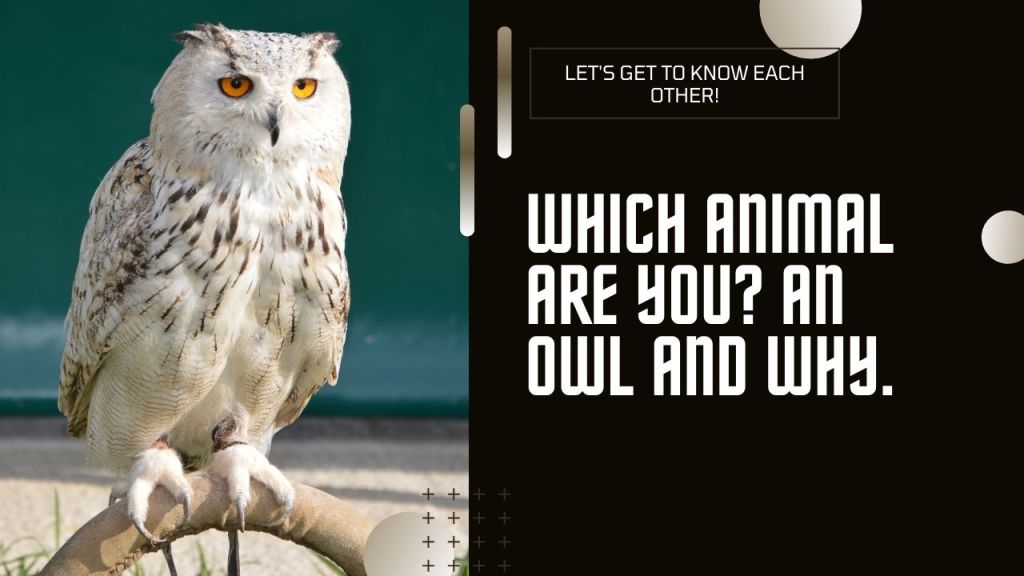
If I were to compare myself to an animal I would compare myself to the owl, because I feel like I live only during the night, the world of the night fascinates me, I wake up when everyone is sleeping, I like to hear the silence of the night I like to watch the shadows in the night, I like to observe the world around me during the night.
I like going out and walking at night it feels like time stands still. People who live at night also have a more original life.
Also during the night my eyes widen like those of the owl, allowing me to observe better.
Like the owl I move noiselessly in the night thanks to my silent wings.
Like the owl I like to use my camouflage and be discreet without people observing me.
Also I have ears adapted to point like the owls which allow me to hear better during the night.
Owls are fascinating birds known for their distinctive characteristics and adaptations. Here are some key features and traits commonly associated with owls:
- Nocturnal Behavior: Owls are primarily nocturnal, meaning they are most active during the night. Their adaptation to low light conditions allows them to hunt effectively in the dark.
- Silent Flight: Owls have specialized feathers that help reduce noise during flight. This adaptation enables them to approach their prey quietly, giving them a stealthy advantage.
- Large Eyes: Owls have large, forward-facing eyes that provide excellent binocular vision, helping them accurately judge distances in low light. Their eyes are fixed in their sockets, so they must turn their heads to see in different directions.
- **Facial Disk
:** Many owl species have a facial disk, a circular arrangement of feathers around their faces that helps funnel sound to their ears. This feature aids in locating prey by enhancing their hearing capabilities.
- Elongated Talons: Owls have powerful, sharp talons adapted for catching and gripping prey. These talons, combined with a strong beak, allow them to capture and consume a variety of prey, including small mammals, birds, and insects.
- Specialized Feathers: The feathers of owls are designed for efficient and silent flight. The leading edges of their wing feathers have a comb-like structure that breaks up the turbulence of air, reducing noise.
- Rotatable Head: Owls have a highly flexible neck that can rotate up to 270 degrees, allowing them to turn their heads almost completely around. This flexibility is essential for scanning their surroundings without moving their bodies.
- Camouflage: The coloration and patterns of an owl’s plumage often provide excellent camouflage in their natural habitats, helping them blend into the surroundings and avoid detection by both predators and prey.
- Adapted Hearing: Owls have exceptional hearing capabilities. Their facial disks play a role in directing sound to their ears, and they have asymmetrical ear openings, allowing them to pinpoint the location of prey accurately.
- Diverse Species: There are over 200 species of owls, and they vary in size, color, and habitat. From the small elf owl to the large eagle owl, owls can be found in a wide range of environments worldwide.
Owls are remarkable birds with a combination of physical adaptations and behaviors that make them well-suited for their nocturnal hunting lifestyle.
Abonnez-vous pour y accéder
Découvrez la suite de ce contenu dès aujourd’hui en vous abonnant.

 www.my-dog-photography.com
Leave a comment